
This lab explores how beak adaptations in finches relate to food sources and competition, mirroring Darwin’s observations on the Galapagos Islands. Analyzing beak morphology
and efficiency will demonstrate natural selection principles.
Historical Context: Darwin’s Finches
Charles Darwin’s voyage on the HMS Beagle led to pivotal observations of finches on the Galapagos Islands. He noticed remarkable variations in beak shapes, directly correlating with available food sources. These finches, though originating from a common ancestor, diversified due to isolation and differing environmental pressures. Darwin’s work highlighted natural selection – the process where advantageous traits become more common in a population over generations. The beaks became a compelling example of adaptive radiation, showcasing evolution in action, and forming the basis for understanding biodiversity.
The Galapagos Islands and Finch Diversity
The Galapagos Islands, a volcanic archipelago, present unique ecological conditions fostering remarkable biodiversity. Isolated from the mainland, these islands became a natural laboratory for evolution. Different islands offered varied food sources – seeds, insects, cacti – driving finch beak adaptations. This isolation allowed populations to diverge, resulting in 13 recognized finch species. Each species exhibits specialized beak morphology suited to its niche, demonstrating how environmental pressures shape evolutionary pathways and promote species diversification.
Purpose of the Lab
This laboratory activity aims to model how natural selection operates on finch populations. Students will investigate the relationship between beak morphology and feeding efficiency with different “food” types; By simulating environmental changes and competition, the lab demonstrates how advantageous traits become more prevalent. The goal is to understand how finches adapted to diverse ecological niches on the Galapagos Islands, illustrating evolutionary principles in action through hands-on experimentation.
Understanding Finch Beak Adaptations
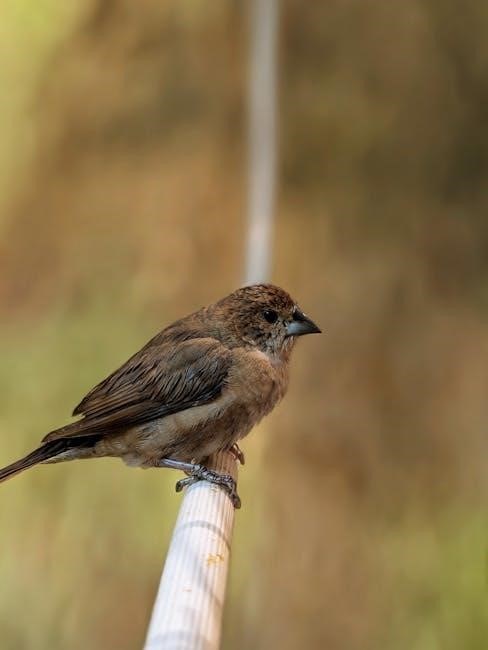
Finches display diverse beak shapes linked to food sources; seed-eating finches showcase variations. Competition drives success for efficient beaks, impacting population numbers over time.
Beak Morphology and Food Sources
Finch beak shapes are directly correlated with their dietary habits. Large, strong beaks effectively crack hard seeds, while smaller, more delicate beaks are suited for smaller seeds or insects. This morphological diversity allows different finch species to exploit various food resources on the Galapagos Islands, minimizing direct competition. Variations in beak size and shape demonstrate adaptation to specific ecological niches, showcasing natural selection’s power. Understanding these relationships is crucial for interpreting lab results and predicting evolutionary outcomes.
Seed-Eating Finches: A Case Study
Seed-eating finches exemplify adaptive radiation, displaying a remarkable range of beak sizes and forms. Ground finches, like the Large Ground Finch, possess robust beaks for cracking large, tough seeds. Smaller finches, conversely, have beaks optimized for consuming smaller seeds. Competition for seed resources drives this diversification, favoring individuals with beaks best suited to available food. This case study highlights how natural selection sculpts traits to enhance survival and reproductive success within a specific environment.
Competition for Resources
Resource competition is a pivotal force in evolution, particularly evident among Galapagos finches. Limited food availability intensifies the struggle for survival, favoring individuals with traits enhancing feeding efficiency. Finches with beaks poorly suited to available seeds face reduced access to nourishment, impacting their reproductive success. Increased competition, as seen in later lab rounds, demonstrates how selective pressure refines adaptations, leading to population shifts and species diversification.
Lab Materials and Procedures
This section details how tools model finch beaks and seeds represent food sources, simulating environmental conditions to observe feeding efficiency and adaptation.
Modeling Finch Beaks with Tools
Various tools – forceps, clothespins, spoons – will simulate diverse finch beak shapes. Each tool represents a specific adaptation for acquiring food. Students will utilize these “beaks” to collect “seeds” (beans, rice, etc.), mirroring natural feeding behaviors. This hands-on approach allows for direct observation of how beak morphology influences feeding success. The effectiveness of each tool will be measured by the quantity of seeds collected within a set timeframe, demonstrating adaptive advantages.
Representing Finch Food (Seeds)
Different seed types – small, medium, and large – will represent the varied food resources available on the Galapagos Islands. These seeds symbolize the selective pressures driving beak evolution. Students will observe how specific “beaks” (tools) are more efficient at collecting certain seed sizes. This demonstrates how competition for resources favors individuals with adaptations suited to available food, influencing population dynamics and species diversification.
Simulating Environmental Conditions
The lab simulates varying environmental pressures through rounds of increasing competition for limited seed resources. Each round represents a shift in the island’s ecosystem, demanding greater foraging efficiency. Students experience how a consistent food supply initially allows multiple beak types to thrive, but increased scarcity favors the most adapted “beaks”. This mimics natural selection’s impact on finch populations over time.
Data Collection and Analysis
Record feeding times for each “beak” and seed type, noting efficiency. Analyze trends to determine which tools excel under different conditions, revealing adaptive advantages.
Measuring Feeding Efficiency
Efficiency is quantified by timing how long each “beak” (tool) takes to collect a specific quantity of “seeds” (food items). Repeat trials for each combination to minimize error and ensure reliable data. Calculate the average time per seed collected, providing a standardized metric for comparison. Higher rates indicate better adaptation to that food source, demonstrating natural selection’s impact. Record all data meticulously in tables, preparing for subsequent analysis and interpretation of results, crucial for understanding finch evolution.
Recording Observations
Detailed notes are essential; document each “beak’s” (tool’s) performance with different “seeds” (food). Observe and record difficulties encountered – dropped seeds, inefficient grasping, or time taken. Note any qualitative differences in technique used with each tool. Include observations about seed size and shape impacting beak effectiveness. Consistent, thorough recording provides valuable context for data analysis, supporting conclusions about adaptation and competition, mirroring Darwin’s finch studies.
Analyzing Data Trends
Examine collected data for patterns: which “beaks” consistently gathered the most “seeds” in each round? Calculate averages for feeding efficiency, noting changes across rounds representing increased competition. Graph results to visually identify trends – do certain beak types excel with specific seed sizes? Look for correlations between beak morphology and success, supporting the link between adaptation and survival, as observed by Darwin with Galapagos finches.

Interpreting Lab Results
Round one shows initial adaptation; round two reveals increased competition favoring efficient beaks; round three demonstrates optimal adaptation for available resources, mirroring natural selection.
Round 1: Initial Adaptation
During the first round, students observe which “beaks” (tools) can most effectively gather available “seeds.” Initial success isn’t about perfection, but rather which tools possess some capability for the task.
Observations should highlight that varied beak shapes demonstrate differing efficiencies. This round establishes a baseline, showing pre-selection variation within the finch population model. Answers will vary, but justifications must link beak type to initial feeding success, demonstrating a basic understanding of adaptation.
Round 2: Increased Competition
Round two introduces heightened competition for limited resources, mirroring natural selection pressures. Students will notice that previously successful “beaks” may struggle as seed availability decreases. This simulates environmental change.
Answers should reflect that only the better adapted beaks survive and reproduce, increasing their frequency in the population. Less efficient tools decline. Justifications must explain how increased competition favors specific beak morphologies, demonstrating selective pressure.
Round 3: Optimal Adaptation
In round three, even more intense competition reveals the “optimal” beak for the available seed types. Answers should demonstrate understanding that the most efficient tools dominate, showcasing natural selection’s refinement.
Students should articulate how specific beak shapes maximized feeding success. Explanations must connect beak morphology directly to resource acquisition, highlighting the survival advantage of perfectly adapted traits within this simulated ecosystem.
Natural Selection and Evolution
Competition drives adaptation, favoring finches with beaks best suited for available resources; “survival of the fittest” explains how populations evolve over time.
How Competition Drives Adaptation
Increased competition, as seen in Round 2 and 3 of the lab, intensifies selective pressure. Finches with less efficient beaks struggle to obtain food, decreasing their survival and reproductive rates. Conversely, those possessing advantageous beak shapes thrive, becoming more numerous. This process demonstrates how environmental demands – specifically, resource availability – directly influence the prevalence of certain traits within a population. Ultimately, competition fuels the evolutionary process, leading to better-adapted finch populations.
Survival of the Fittest
“Survival of the fittest” isn’t about physical strength, but reproductive success. Finches with beaks best suited to available food sources gather resources more efficiently, increasing their chances of survival and reproduction. These advantageous traits are then passed to offspring. Less adapted finches face hardship, reducing their reproductive output. This differential survival and reproduction is the core mechanism driving evolutionary change, favoring traits that enhance fitness in a specific environment.
The Role of Isolation
Geographic isolation is crucial for speciation. When finch populations become separated on different Galapagos Islands, gene flow is restricted. Each island presents unique food sources, driving natural selection towards different beak adaptations. Over time, these isolated populations diverge genetically, becoming distinct species unable to interbreed. Isolation allows for independent evolutionary trajectories, fostering the remarkable diversity observed in Darwin’s finches.
Island Ecosystems and Finch Populations
Galapagos Islands support diverse finch species due to resource partitioning and varied habitats. Lab materials help test how different beak types exploit specific food sources.
Supporting Multiple Finch Species
Island ecosystems can sustain numerous finch species because of niche specialization, minimizing direct competition. Different beak morphologies allow finches to efficiently exploit varied food resources – large seeds, small seeds, insects, and cactus fruits. This lab demonstrates how resource partitioning enables coexistence. Specifically, Large Ground Finches and Small Ground Finches can thrive by focusing on different seed sizes, reducing competitive overlap. Using lab materials, students can model this by testing beak tools with various seed types, illustrating adaptive radiation.
Testing Explanations with Lab Materials
Students can test their hypotheses about resource partitioning using the provided tools. For example, different “beaks” (tweezers, pliers, clothespins) represent varied finch morphologies. By timing how efficiently each “beak” collects specific “seeds” (beans, rice, etc.), students quantify feeding success. This simulates environmental pressures and demonstrates how beak shape influences resource acquisition. Analyzing data reveals which tools are best suited for each food type, supporting the idea of adaptive specialization and niche differentiation.
Common Misconceptions
A frequent error is believing finches consciously change beaks. Instead, natural selection favors individuals with pre-existing, advantageous traits passed down through generations.
Incorrect Assumptions About Finch Behavior
Many students incorrectly assume finches actively modify their beak shape during their lifetime to better access food. This misunderstanding overlooks the core principle of inherited traits. Beak variations already exist within a population; natural selection doesn’t create new beaks, but rather favors those best suited for available resources. Finches don’t ‘decide’ to change; those with advantageous beaks survive and reproduce more successfully, gradually shifting the population’s characteristics over generations. This process highlights the importance of genetic inheritance, not individual adaptation.
Addressing the “Changing Beaks” Idea
The misconception of finches altering beak shape stems from observing correlation as causation. While beak size correlates with food availability, it’s not a direct result of conscious effort. Instead, finches with pre-existing, advantageous beak traits have higher survival rates; This differential reproduction leads to a population increasingly dominated by those beneficial traits. Emphasize that natural selection acts on existing variation, not by inducing changes within an individual’s lifetime. The lab demonstrates this through tool efficiency, not beak ‘transformation’.
The Importance of Inherited Traits
Beak morphology isn’t acquired during a finch’s life; it’s genetically determined and passed down through generations. Successful foraging with a specific beak type doesn’t cause offspring to inherit that beak, but rather, finches with that beak are more likely to reproduce. This highlights the crucial role of inherited variation in natural selection. The lab models this by showing how ‘better’ tools (beaks) lead to more ‘offspring’ (seeds collected), demonstrating trait inheritance’s significance.
Answer Key Considerations
Answers will vary, but justifications are key! Students should explain why certain “beaks” were more effective, demonstrating understanding of adaptation and competition.
Variability in Answers
Expect diverse responses regarding beak effectiveness for different seed types. Students may reasonably argue for slight variations in efficiency based on technique and tool handling. The focus should be on the reasoning behind their choices, not a single “correct” answer. Accept well-supported explanations demonstrating understanding of adaptive traits and competitive advantages. Consider that observational skills and data interpretation will naturally differ, leading to nuanced conclusions about beak adaptation and survival.
Justification of Choices
Students must articulate why a particular “beak” (tool) was most effective for a specific “food” (seed). Emphasis should be placed on linking beak morphology to feeding efficiency – how shape and size aided acquisition. Acceptable justifications include descriptions of grasping, cracking, or probing abilities. Assess if they connect tool selection to simulated environmental pressures, like increased competition, and explain how this impacts survival rates.
Applying Lab Concepts
Adaptation principles extend beyond finches; consider insect mouthparts or giraffe necks. Environmental shifts drive selection, impacting species survival and demonstrating evolution’s ongoing power.
Real-World Examples of Adaptation
Consider the peppered moth’s color change during the Industrial Revolution, a classic example of adaptation to pollution. Similarly, antibiotic resistance in bacteria showcases rapid evolution under selective pressure. Camouflage in various animals, like chameleons or stick insects, illustrates adaptation for predator avoidance. These examples, mirroring finch beak variations, demonstrate how populations evolve traits enhancing survival and reproduction in changing environments, proving natural selection’s pervasive influence.
The Impact of Environmental Change
Environmental shifts, like drought or new predator introduction, drastically impact species. Finches, facing altered food availability, exhibit beak size changes over generations. Climate change presents a modern challenge, altering habitats and resource distribution. Species unable to adapt face decline or extinction, highlighting vulnerability. Understanding these impacts is crucial for conservation efforts, mirroring the finch lab’s demonstration of adaptation’s necessity for survival in a dynamic world.
Further Research
Investigate diverse finch species and detailed beak morphology. Explore genetic factors influencing beak development and adaptation. Analyze long-term evolutionary trends within finch populations.
Exploring Different Finch Species
Delve into the unique adaptations of various finch species beyond those modeled in the lab. Consider the Cactus Finch, with its long, probing beak for nectar, or the Vegetarian Finch, utilizing buds and pollen. Research how environmental pressures on different islands shaped specialized beak structures. Compare and contrast beak morphologies across species, linking them to specific food sources and ecological niches. Investigate the genetic basis for these variations, understanding how natural selection drives diversification within the finch family. Examine how isolation contributes to speciation and the emergence of new finch varieties.
Investigating Beak Morphology in Detail
Analyze precise beak measurements – length, depth, and width – across different finch species. Utilize imaging techniques to visualize internal beak structures and muscle attachments. Correlate beak shape with the mechanics of food processing, like cracking seeds or probing flowers. Examine how beak morphology influences feeding efficiency and resource utilization. Consider the role of developmental genes in shaping beak form. Explore the evolutionary history of beak traits, tracing their changes over time. Document variations within populations, revealing the extent of phenotypic plasticity.
Lab Report Components
A comprehensive report should include an introduction with a hypothesis, detailed methods, presented results, a thorough discussion, and a concluding summary of findings.
The introduction should contextualize Darwin’s finch studies and natural selection, explaining how beak variations correlate with available food sources on the Galapagos Islands. Clearly state the lab’s purpose: to model and analyze how different “beak” tools affect feeding efficiency with varying “seed” sizes. Your hypothesis should predict which tool (beak) will be most effective for each seed type, justifying your prediction based on morphological features and anticipated feeding success.
Methods and Materials
This section details the experimental setup. Materials included various “beak” tools (e.g., forceps, clothespins, spoons) representing finch beak morphology, and different “seed” types (e.g., small seeds, large seeds) simulating island food resources. The procedure involved using each tool to collect seeds for a set time, recording the quantity collected, and repeating trials to ensure data reliability. Environmental conditions were kept consistent.
Results and Discussion
Data analysis revealed that certain “beaks” were significantly more efficient at collecting specific “seed” types. For example, forceps excelled with small seeds, while clothespins were better suited for larger ones. These findings demonstrate a direct correlation between beak morphology and feeding efficiency. Increased competition (simulated rounds) favored the most effective tools, mirroring natural selection’s impact on finch populations.
This lab vividly illustrates how environmental pressures drive adaptation through natural selection, impacting finch beak morphology and survival rates on islands.
Summarizing Key Findings
The lab demonstrated a clear correlation between beak structure and feeding efficiency, showcasing how finches with beaks best suited to available food sources thrived. Increased competition intensified selection, favoring optimal adaptations. We observed that diverse beak morphologies allow multiple finch species to coexist by exploiting different niches. Ultimately, this activity reinforces the principles of natural selection and adaptive radiation, mirroring Darwin’s groundbreaking work on the Galapagos Islands, and highlighting inherited traits.
The Significance of Finch Beak Adaptations
Finch beak adaptations exemplify evolution driven by environmental pressures, specifically food availability and competition. These variations aren’t random; they’re inherited traits enhancing survival and reproduction. The Galapagos finches illustrate how isolation fosters diversification, leading to specialized species; Understanding these adaptations provides insight into the mechanisms of natural selection and the interconnectedness of organisms and their ecosystems, demonstrating evolution in action.
Resources and References
Explore scientific articles detailing Darwin’s finches and evolutionary biology. Online educational platforms offer supplementary materials for deeper understanding of beak adaptations and natural selection.
Relevant Scientific Articles
Schluter, D. (2000). The ecology of adaptive radiation. Oxford University Press provides a comprehensive overview of adaptive radiation, including detailed analyses of Darwin’s finches. Grant, P. R., & Grant, B. R. (2003). How and why species multiply: The radiation of Darwin’s finches. Princeton University Press offers in-depth research on the finches’ evolutionary history and beak morphology. Additionally, research published in Evolution and The American Naturalist frequently features studies on beak adaptations and natural selection in bird populations, offering valuable insights for lab interpretation.
Online Educational Materials
The Howard Hughes Medical Institute’s BioInteractive website (https://www.biointeractive.org/) features excellent resources on evolution and Darwin’s finches, including virtual labs and interactive simulations. PBS LearningMedia (https://www.pbslearningmedia.org/) offers videos and lesson plans related to natural selection. Furthermore, the University of California Museum of Paleontology’s website (https://ucmp.berkeley.edu/) provides detailed information on evolutionary biology and the Galapagos finches.